
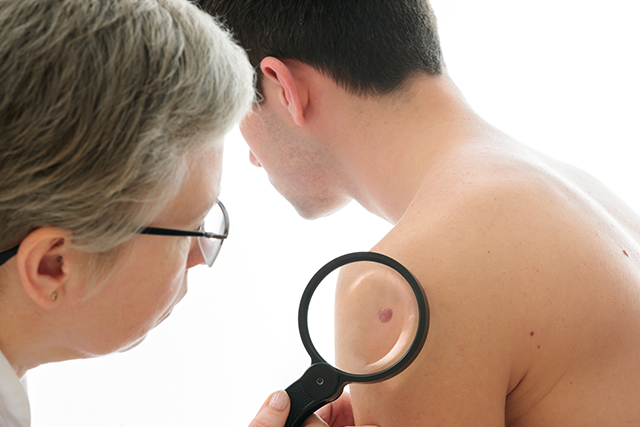
“Is this mole normal?” It’s one of the most common questions we hear at Flower Mound Dermatology, and it’s one worth asking. Most moles are completely harmless, but melanoma — the most serious form of skin cancer — often begins as a new spot or a change in an existing mole. Here in North Texas, where intense sun exposure is a year-round reality, knowing what to look for can genuinely save your life. The good news? When melanoma is caught early, the five-year survival rate is over 99%. Early detection starts with knowing your own skin.
The easiest way to evaluate a mole at home is the ABCDE method. A is for Asymmetry — one half of the mole doesn’t match the other. B is for Border — the edges are ragged, notched, or blurred rather than smooth. C is for Color — the mole contains multiple shades of brown, black, red, white, or blue instead of one uniform color. D is for Diameter — the spot is larger than 6 millimeters, about the size of a pencil eraser. E is for Evolving — the mole is changing in size, shape, color, or elevation, or it has started itching, bleeding, or crusting. Any single one of these signs is reason enough to have a dermatologist take a look.
Beyond the ABCDEs, dermatologists also watch for the “ugly duckling” sign — a mole that simply looks different from all the others on your body. If most of your moles are small and light brown but one is dark, raised, or growing, that outlier deserves attention. It’s also important to know that melanoma doesn’t only appear in sun-exposed areas. It can develop on the scalp, between the toes, under fingernails, and in other places you rarely see, which is why a professional full-body skin exam matters even if nothing looks alarming to you.
So how often should you be checked? For most adults, an annual full-body skin exam is a smart baseline, and people with fair skin, a history of sunburns, tanning bed use, many moles, or a family history of skin cancer may need to come in more often. Between visits, do a quick self-check once a month — use a mirror or ask a partner to help with hard-to-see spots. If you’ve noticed a mole that’s new, changing, or just doesn’t look right, don’t wait and wonder. Schedule a skin check with Flower Mound Dermatology, and get an expert answer in a single visit.