
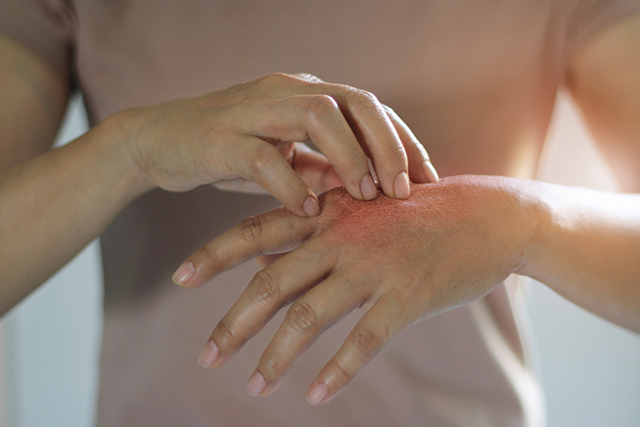
The first real cold front of the season is a relief in North Texas, until your skin notices. Humidity drops, the furnace kicks on, showers get hotter, and within a couple of weeks your shins are flaky, your hands are cracked, and you’re scratching without realizing it. For many people that’s simple seasonal dryness. For others it’s the start of an eczema flare. Eczema, known medically as atopic dermatitis, affects roughly one in ten Americans at some point in their lives. It isn’t only a childhood condition, and many patients we see at Flower Mound Dermatology develop it for the first time as adults. It’s often mistaken for “just dry skin” for years.
The difference comes down to how your skin behaves. Ordinary dryness is diffuse, mildly itchy, and improves within a week or two of consistent moisturizing. Eczema produces distinct patches of inflamed, intensely itchy skin that keep returning to the same places. Common spots are the inner elbows, the backs of the knees, the hands, the neck, and the eyelids. The itch is frequently worse at night and often begins before the rash is visible. On lighter skin the patches look red. On medium and deeper skin tones they may appear brown, purple, or gray, which is one reason eczema is often missed. Oozing, crusting, or sudden pain can signal an infection. Several conditions can also imitate eczema, including psoriasis, contact allergies, and fungal rashes, and each needs a different treatment. That is why an accurate diagnosis matters.
Whichever you’re dealing with, daily habits do much of the work. Keep showers short and lukewarm, since hot water strips the oils your skin barrier depends on. Use a gentle, fragrance-free cleanser. Apply a thick cream or ointment within a few minutes of patting dry, while the skin is still damp. Products that come in a tub or tube generally outperform thin lotions from a pump. Switch to fragrance-free laundry detergent, choose cotton over wool against the skin, and consider a bedroom humidifier once the heat is running. Be cautious with heavily fragranced “soothing” products and essential oils, which are common triggers for flares.
If two weeks of good care isn’t helping, it’s time to be seen. Other reasons to come in are itching that disrupts your sleep or a rash that keeps coming back. Eczema treatment has advanced considerably in recent years. Prescription topical steroids calm flares quickly when used correctly. Newer non-steroid creams are safe for delicate areas such as the face and eyelids. Patients with moderate to severe eczema now have targeted biologic and oral medications that can change daily life, and when a contact allergy is suspected, identifying the culprit can stop the cycle entirely. You don’t have to scratch your way through another winter. Schedule a visit with Flower Mound Dermatology and let us build a plan that keeps your skin comfortable all season.